Class 12 Chemistry Electrochemistry & Chemical Kinetics — Complete Guide for Burari Students
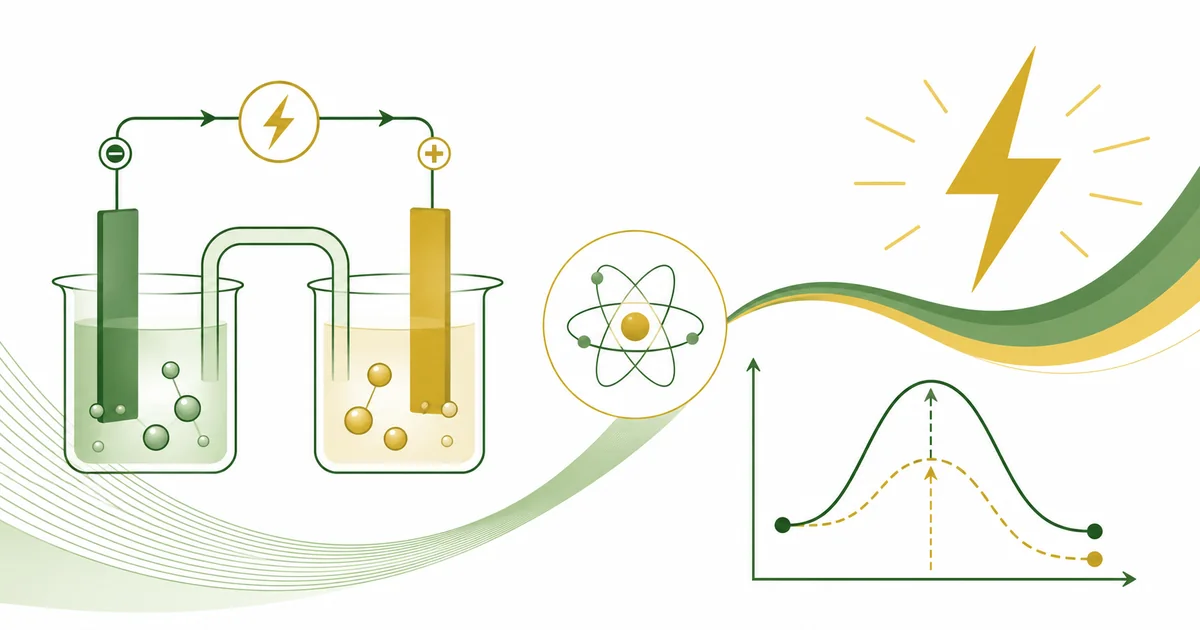
Physical Chemistry in Class 12 is built on two towering chapters: Electrochemistry and Chemical Kinetics. Together they carry more numerical weight than almost any other section in the Chemistry paper. If you are looking for Class 12 Chemistry Electrochemistry coaching in Burari, this guide will walk you through every core concept, formula, and exam pattern I have refined over ten years of teaching at Grow Up Coaching Centre in Sant Nagar. These chapters reward students who practise with discipline and understand the logic behind each equation.
Why These Two Chapters Decide Your Class 12 Chemistry Score
Let me lay out the stakes clearly. In CBSE board exams, Electrochemistry and Chemical Kinetics together contribute 10 to 13 marks, including a compulsory numerical question and at least one derivation or conceptual reasoning question. In JEE Main, Electrochemistry alone consistently yields 1 to 2 questions, and Chemical Kinetics another 1 to 2. These are not chapters you can skim. They are dense with formulas, graph interpretations, and numericals that test your ability to apply concepts rather than simply recall facts. I have seen students from Bengali Colony and Rishi Nagar who initially found these chapters intimidating but ended up scoring full marks on them after focused, systematic preparation. The key is to treat them as problem-solving subjects, not theory subjects.
Electrochemistry — The Chemistry of Charge Flow
Electrochemistry connects chemistry with electricity. It studies how chemical reactions produce electrical energy (galvanic cells) and how electrical energy drives non-spontaneous chemical reactions (electrolytic cells). The chapter is built around the Nernst equation, which adjusts cell potentials for non-standard conditions, and Faraday's laws, which quantify the relationship between charge passed and the amount of substance deposited or dissolved. Conductance, molar conductivity, and Kohlrausch's law form the third major section. Every part of this chapter is numerical and concept-heavy.
The Nernst Equation — Your Most Important Tool
For a general electrode reaction Mn+ + ne⁻ → M, the electrode potential is E = E° - (RT/nF) ln(1/[Mn+]), which simplifies at 298 K to E = E° - (0.0591/n) log(1/[Mn+]). For a full cell, Ecell = E°cell - (0.0591/n) log Q, where Q is the reaction quotient. This equation allows you to calculate the emf of a cell when concentrations are not 1 M. One common trick: when the cell reaction reaches equilibrium, Ecell = 0, and Q = Kc. Then E°cell = (0.0591/n) log Kc. This relationship is used to find equilibrium constants from electrochemical data. Board questions often ask you to calculate E°cell from given half-cell potentials and then find the equilibrium constant. Practise this sequence ten times — it is a guaranteed 3-mark or 5-mark question.
Conductance and Kohlrausch's Law
Conductance (G) is the reciprocal of resistance. Specific conductance (κ) is the conductance of a cell with electrodes of unit area separated by unit distance. Molar conductivity (Λm) is κ divided by concentration in mol/m³, giving Λm = κ / c. The unit is S m² mol⁻¹ or S cm² mol⁻¹. For strong electrolytes, Λm decreases slowly with dilution due to decreased ion-ion interactions. For weak electrolytes, Λm increases steeply with dilution because the degree of dissociation increases. Kohlrausch's law states that the molar conductivity at infinite dilution (Λ°m) for any electrolyte is the sum of the independent contributions of its cation and anion: Λ°m = ν+ λ°+ + ν- λ°-. This law is used to calculate Λ°m for weak electrolytes, which cannot be obtained by extrapolation. It is also used to find the degree of dissociation α = Λm / Λ°m for a weak electrolyte. I always tell my students in Sant Nagar to treat Kohlrausch's law problems like simple algebra — add the ionic conductivities with the correct stoichiometric coefficients, and the answer falls out neatly.
Faraday's Laws of Electrolysis
First law: The mass of a substance deposited or liberated at an electrode is directly proportional to the quantity of electricity passed (m = Z Q, where Z is the electrochemical equivalent). Second law: When the same quantity of electricity is passed through different electrolytes, the masses deposited are in the ratio of their equivalent weights. The key numerical formula is m = (M I t) / (n F), where M is molar mass, I is current, t is time, n is the number of electrons involved per ion, and F is Faraday's constant (96500 C/mol). Students often confuse n — it's the number of electrons in the half-reaction. For Cu²⁺ + 2e⁻ → Cu, n = 2. For Ag⁺ + e⁻ → Ag, n = 1. Write the half-reaction explicitly before plugging values. I have seen this simple step save students from careless mistakes in both board exams and JEE.
Chemical Kinetics — The Speed of Reactions
Chemical Kinetics deals with the rates of chemical reactions and the factors that affect them. The chapter covers rate laws, order of reaction, molecularity, the integrated rate equations for zero and first-order reactions, half-life, the Arrhenius equation, and the collision theory of bimolecular reactions. Every part of this chapter can appear as a numerical, a graph, or a conceptual reasoning question.
Rate Law and Order of Reaction
The rate of a reaction is expressed as the change in concentration per unit time: Rate = -d[R]/dt. For a reaction aA + bB → products, the rate law is Rate = k [A]ᵐ [B]ⁿ, where m and n are the orders with respect to A and B, and m+n is the overall order. Order is experimental — it does not come from the stoichiometric coefficients except for elementary reactions. Molecularity is the number of molecules colliding in an elementary step; it is always a whole number. Order can be zero, fractional, or even negative. The unit of the rate constant k depends on the overall order: for zero order, mol L⁻¹ s⁻¹; for first order, s⁻¹; for second order, L mol⁻¹ s⁻¹. A frequent board question asks you to determine the order from given initial rate data. Use the method of initial rates: compare two experiments where the concentration of one reactant changes while the other is constant, and see how the rate changes. The ratio of rates equals the ratio of concentrations raised to the order. Solve for the exponent. It is pure logic — practise five such problems and you will never hesitate.
Integrated Rate Laws and Half-Life
For a zero-order reaction: [R] = [R]₀ - kt. The graph of [R] versus time is a straight line with slope -k. The half-life t1/2 = [R]₀ / 2k. For a first-order reaction: ln[R] = ln[R]₀ - kt, or in exponential form [R] = [R]₀ e⁻ᵏᵗ. The graph of ln[R] versus time is a straight line with slope -k. The half-life t1/2 = 0.693/k, which is independent of initial concentration. This independence is a unique diagnostic feature of first-order reactions. The time taken for a certain fraction of the reaction to complete is also a constant multiple of the half-life: for 99.9% completion, t = 10 t1/2. These fraction-of-life problems are very common. I train students at Burari to recognise that for a first-order reaction, the time to go from 50% to 75% completion is exactly one half-life, just like the time from 0% to 50%. The fraction remaining after n half-lives is (1/2)ⁿ.
The Arrhenius Equation
The Arrhenius equation links the rate constant to temperature: k = A e⁻ᴱᵃ/ᴿᵀ, where Ea is the activation energy and A is the pre-exponential factor. Taking natural logs: ln k = ln A - Ea/(RT). The graph of ln k versus 1/T is a straight line with slope -Ea/R. For two temperatures, ln(k₂/k₁) = (Ea/R)(1/T₁ - 1/T₂). This two-point form is heavily used in numericals. Always convert temperatures to Kelvin. Always use R = 8.314 J K⁻¹ mol⁻¹ when Ea is in joules. A common exam mistake is using R = 0.0821 L atm, which is for the ideal gas law, not for energy calculations. I drill this distinction into every student at our Sant Nagar centre.
Common Mistakes in Electrochemistry and Chemical Kinetics
After a decade of grading Chemistry papers from students across 110084, here are the errors I correct most often.
- Forgetting the sign convention in Nernst equation for cell potentials. Ecell = E°cell - (RT/nF) ln Q. If Q is large, Ecell decreases. Students sometimes add the term instead of subtracting it. Always check: if the product concentration increases, the cell should move towards equilibrium and the emf should decrease. The minus sign enforces that logic.
- Mixing up equivalent weight and molar mass in Faraday's law problems. The second law involves equivalent weights, but in numericals using m = (M I t)/(n F), you are using molar mass divided by n, which is exactly the equivalent weight. Do not double-apply the n factor. Identify the half-reaction, find n, and use molar mass directly in the formula.
- Assuming the stoichiometric coefficient is the order of reaction. This is true only for elementary reactions. For complex reactions, the order must be determined experimentally. A classic trap: the reaction 2N₂O₅ → 4NO₂ + O₂ is first order, not second order. Always check the given rate law or experimental data before concluding.
- Using Celsius instead of Kelvin in the Arrhenius equation. The two-point Arrhenius formula uses absolute temperatures. Plugging in 25°C instead of 298 K gives a wildly wrong result. Write "Convert to Kelvin" on your question paper as soon as you read an Arrhenius problem.
- Confusing conductance with conductivity. Conductance G = 1/R, unit siemens (S). Conductivity or specific conductance κ = G (l/A), unit S m⁻¹. Molar conductivity Λm = κ / c. These are three different quantities with different units. Mixing them up leads to unit errors and wrong answers. Keep a small definitions table in your notes.
How to Prepare These Chapters for Boards and JEE Together
- Create a dedicated formula sheet for Electrochemistry and Chemical Kinetics combined. List every equation: Nernst equation (both forms), relationship between E°cell and Kc, Faraday's law, Kohlrausch's law, rate law, integrated rate laws for zero and first order, half-life expressions, Arrhenius equation (both forms). Keep it to one page. Revise it for five minutes before starting any problem set.
- Solve all NCERT intext questions and back exercises. The NCERT Electrochemistry chapter contains excellent numericals on cell emf, conductance, and electrolysis. The Chemical Kinetics NCERT exercises have a perfect mix of rate law determination, half-life calculations, and Arrhenius problems. Many board questions are directly adapted from these exercises.
- Practise graph interpretation actively. Sketch the graphs for a first-order reaction (ln[R] vs time, t1/2 vs [R]₀), for a zero-order reaction ([R] vs time), and for the Arrhenius plot (ln k vs 1/T). Understand the slope and intercept in each case. Board examiners love asking "What does the slope of this graph represent?"
- For JEE, practise problems involving mixed concepts. Some JEE questions combine Electrochemistry with Thermodynamics (ΔG° = -nFE°cell) or Chemical Kinetics with radioactive decay (which follows first-order kinetics). The relationship ΔG° = -nFE°cell is central — it links the free energy change to the cell potential. Know it thoroughly.
Why Small-Batch Coaching Transforms Physical Chemistry Performance
Physical Chemistry is problem-solving. A student sitting in a crowded classroom can easily copy a solution from the board without truly understanding the steps. But when they face a slightly different problem in the exam, that superficial understanding collapses. At Grow Up Coaching Centre in Sant Nagar, Burari, I can watch each student work through a Nernst equation problem individually. I can see where they pause, where they hesitate, and I can correct their approach right there. That personalised feedback loop is impossible in a batch of sixty or a hundred students.
Students from Nathupura and Amrit Vihar have told me that they never really understood why the half-life of a first-order reaction is constant until we sat together and derived it step by step, with them asking questions at every line. That moment of genuine understanding is what changes a student's relationship with Chemistry forever. Our centre at Sant Nagar, 110084 exists to create those moments.
Three Practical Tips from an Experienced Chemistry Teacher
Tip 1: Use the log form of the Nernst equation with 0.0591 at 298 K for speed. For most board and JEE problems at room temperature, Ecell = E°cell - (0.0591/n) log Q. This avoids plugging in R, T, and F every time. Just check that the temperature is 298 K. If the question gives a different temperature, revert to the full RT/nF form. This shortcut saves valuable minutes.
Tip 2: For first-order kinetics, remember that the fraction remaining after time t is e⁻ᵏᵗ. If a problem asks "what percentage of the reactant remains after 30 minutes?" do not calculate the full concentration. Use [R]/[R]₀ = e⁻ᵏᵗ directly. First find k from half-life if needed: k = 0.693/t1/2. Then compute e⁻ᵏᵗ. This method is faster than the log form and reduces algebraic errors.
Tip 3: In electrolysis problems, always balance the half-reaction first, then count electrons. The number of electrons n is the coefficient in front of e⁻ in the balanced half-reaction. For the discharge of Al³⁺ to Al, n = 3. For the oxidation of Cl⁻ to Cl₂, 2Cl⁻ → Cl₂ + 2e⁻, so n = 2 per Cl₂ molecule, but n = 1 per Cl atom. Be clear what the question is asking — mass per mole of product atoms or product molecules. Precision here prevents mistakes.
Why Families Across Burari Choose Grow Up Coaching Centre for Class 12 PCM
We are a neighbourhood coaching centre with a clear identity. We teach Class 10 Maths and Science, and Class 11-12 PCM with JEE/NEET foundation. We do not dilute our focus. Every student who walks into our centre in Sant Nagar is known by name, their strengths understood, and their weaknesses addressed patiently. Parents from Bengali Colony, Nathupura, Himgiri Enclave, and all around Burari have placed their trust in us for years because we deliver what we promise — a genuine, caring, and effective education.
Electrochemistry and Chemical Kinetics may seem dense, but they are among the most logical topics in the entire syllabus. With the right teacher, they become not just manageable but enjoyable. I look forward to showing you exactly how.
Take the First Step — Book a Free Demo Class
You can experience our teaching approach with zero commitment. We offer a free demo class on Electrochemistry or Chemical Kinetics. Attend the session, watch how we break down a Nernst equation problem or an Arrhenius calculation, and decide for yourself if our style works for you. No pressure, no cost, just a real class.
To book your free demo, call or WhatsApp 096671 22571. You can also visit us at Grow Up Coaching Centre, Sant Nagar, Block B, Burari, New Delhi – 110084. We are easy to find and always ready to welcome new students. If our coaching has already helped you or your child, please take a moment to leave a Google review. It helps families across Burari discover quality Class 12 Chemistry Electrochemistry coaching in Burari, and your honest feedback supports a small local business dedicated to student success.
You may also find our other PCM study guides helpful as you plan your preparation.
FAQs
What is the most important numerical topic in Class 12 Electrochemistry?
The Nernst equation and its application to calculate cell emf, equilibrium constants, and unknown concentrations is the most critical numerical topic. Faraday's laws of electrolysis, including calculations of mass deposited and current efficiency, are also frequently tested. Kohlrausch's law numericals for determining molar conductivity at infinite dilution and degree of dissociation of weak electrolytes complete the core numerical set. Practise each type at least five times to build confidence.
How do I determine the order of a reaction from experimental data?
Use the method of initial rates. Compare two experiments where the concentration of one reactant is changed while the other reactant's concentration is held constant. If doubling the concentration of A doubles the rate, the reaction is first order with respect to A. If doubling A quadruples the rate, it is second order with respect to A. If changing A does not affect the rate, it is zero order. The overall order is the sum of the individual orders. Always verify with at least two data pairs to ensure consistency.
Where can I get expert Class 12 Chemistry coaching for Physical Chemistry in Burari?
Grow Up Coaching Centre in Sant Nagar, Block B, Burari, New Delhi – 110084 offers focused Class 12 PCM coaching with small batches and individual attention. The centre covers Electrochemistry, Chemical Kinetics, and all other Physical Chemistry topics with an emphasis on problem-solving and exam preparation for CBSE and JEE. Students from Sant Nagar, Bengali Colony, Kamal Vihar, Nathupura, and surrounding areas can easily attend. To book a free demo class, call or WhatsApp 096671 22571.
Book a FREE Class 12 Chemistry Demo
Sant Nagar, Burari · Mon–Sat 9 AM–9 PM · Call or WhatsApp 096671 22571
💬 WhatsApp a Demo