Parent-Teacher Meetings at Grow Up Coaching Centre — How They Work
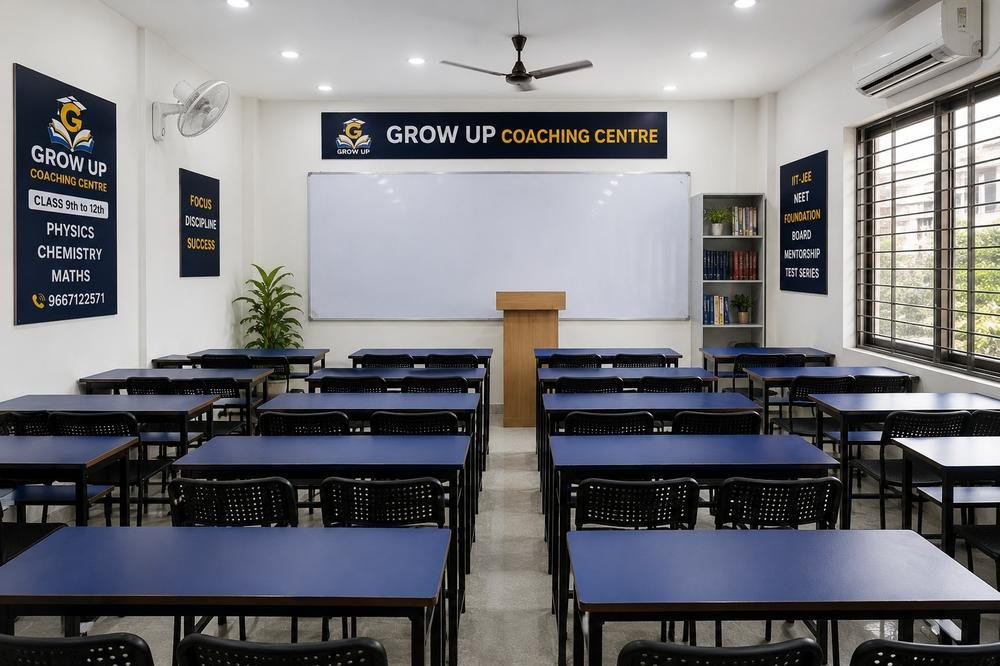
A mother from Laxmi Vihar once told me that the only time she heard from her son's previous coaching was when the fee was due. She never knew if he was struggling until the half‑yearly report card came. That's the opposite of how we work. At our Sant Nagar centre, a parent‑teacher meeting isn't a once‑a‑year formality. It's an ongoing conversation. And it's the reason a lot of students who were sliding quietly in other places start improving here — because someone noticed, and someone told the family what to do.
Quick answer — how our parent‑teacher meetings work. We hold short catch‑ups every two months, plus a detailed sit‑down after every major mock test. Parents from Bengali Colony, Kamal Vihar, Rishi Nagar, and beyond also drop by unannounced anytime between 9 AM and 9 PM. The meetings are three‑way — teacher, student, parent — and focus on specific, actionable changes, not just marks. Call or WhatsApp 096671 22571 to know more or visit the centre.
Why we do meetings differently — and why it matters
In a big coaching institute, a parent‑teacher meeting is a rushed affair. A hundred parents queue up, a teacher reads out marks, and you're out in three minutes. Nothing real is shared. At our small‑batch centre, I have the time to keep an observation log for each child. If a student has been making the same sign error in integration for three weeks, I note it. If they've suddenly started participating more after being silent, I note that too. When the parent comes in, I'm not guessing — I'm pulling out a notebook and showing them. That changes the conversation from “your child is weak” to “here's what we need to fix and here's how.”
The rhythm — when meetings happen and what they cover
Every two months, we schedule a 20‑minute informal catch‑up. It's a Saturday morning, when most parents in Burari are free. I put three chairs in the corner of the room — teacher, parent, student. We go over the last eight weeks. Not just the test scores, but the homework completion rate, the quality of rough work, the number of doubts asked. After every major mock test — usually in September, December, and February — we do a longer session. That's when we bring out the answer sheets and compare them with previous ones. A mother from Harit Vihar once broke into a relieved smile when I showed her that her son's calculus marks had climbed from 3/10 to 8/10 over three tests. She hadn't seen it at home because he was hiding the papers. The meeting brought it into the open.
What parents actually learn that a report card won't tell them
A report card says “Physics: 62%.” It doesn't say that the student lost 15 marks because they didn't draw vector diagrams, or that they wrote the derivation correctly but skipped the final unit. In our meetings, I open the test paper and point to the red marks. I explain why each mark was cut. A father from Amrit Vihar once realised during a meeting that his daughter was losing marks not because she didn't understand the Physics, but because she was rushing and missing the “hence proved” statement. He started checking her notebook for that one habit every evening. Two tests later, she was scoring 10 marks higher. That's the kind of granular feedback a parent needs but rarely gets.
The student is in the room — and that changes everything
I never hold meetings without the student present. This is deliberate. When a parent and a teacher talk about a child behind their back, the child feels conspired against. When everyone sits together, the student gets to explain their side first. I ask, “What do you think went well, and what didn't?” Most kids are brutally honest when they're not being scolded. A Class 12 boy from Timarpur told his mother during a meeting that he wasn't completing the daily chemistry sheets because he was scared of getting the organic mechanisms wrong. I hadn't realised that. We adjusted the homework, gave him extra drawing practice, and the fear dissolved within a fortnight. Without that meeting, he'd have continued hiding and failing.
What parents are asked to do — simple, real‑world actions
I never burden a parent with “teach him trigonometry.” That's my job. What I ask is smaller and more powerful. Check if the child is solving the daily problem sheet before scrolling on the phone. Ensure a proper meal before the evening batch. Create one quiet hour at home after coaching — no TV, no guests. These are things every parent in Nathupura, Baba Colony, and Sant Nagar can do. And when they do them consistently, the coaching starts to stick. I've seen a child's Physics score jump from 50 to 70 simply because the mother started enforcing a no‑phone rule from 8 PM to 9 PM.
Open door — not a slogan, a practice
Parents don't need to wait for a formal meeting. I've had a father from Shastri Park walk in at 11 AM on a Tuesday, worried because his son had scored badly in a school test. We sat for fifteen minutes, looked at the paper, and came up with a three‑step fix. The son was in class at 4 PM that same day with a clear plan. That immediacy is impossible in a large setup where the teacher is unreachable outside the lecture hall. It's possible here because Sant Nagar is a five‑minute walk from most of these colonies, and my door — literally — is open.
If you're a parent who's been kept in the dark about your child's PCM progress, come see how we do things. Sit through a demo. Ask me about a current student's trajectory. The conversation will tell you more than any brochure. Call or WhatsApp 096671 22571. The meeting could change your child's year.
How often do you hold parent-teacher meetings at your Sant Nagar centre?
We don't wait for a semester to end. We schedule a brief catch-up every two months, and a more detailed one after each major mock test. Parents can also walk in anytime between 9 AM and 9 PM, Monday to Saturday, without an appointment.
What do you discuss during a parent-teacher meeting?
We go through the student's notebook, recent test papers, and the teacher's observation log. Instead of just marks, we talk about specific areas — like 'algebraic simplification speed' or 'drawing free-body diagrams' — and give the parent three small actions they can support at home.
Can I visit the centre even if there's no formal meeting?
Absolutely. Our centre in Sant Nagar, Block B, has an open-door policy. If a parent is worried about their child's progress, they can drop in any working day. We'll sit down and talk, even if it's just for ten minutes.
Do you involve the student in the meeting, or is it just the parents?
We always involve the student. The meeting is a three-way conversation. The student explains their own challenges first, then the teacher shares observations, and finally the parent adds what they see at home. This removes blame and builds a team approach.
Not just marks — real conversations. Book a free parent counselling session.
Sant Nagar, Burari · Mon–Sat 9 AM–9 PM · Call or WhatsApp 096671 22571
💬 WhatsApp to Talk