PCM Coaching for Weak Students in Burari — How We Help
A Class 11 student from Nathupura once told me, “Sir, main Maths mein zero hoon. School mein sab bolte hain PCM chhod do.” It broke my heart a little. He wasn't a zero — he just had gaps from Class 9 and 10 that nobody had fixed. I worked with him for four months. He passed Class 11 with decent marks. Not a topper, but he didn't fail, and that was a victory. This post is for every parent and student in Burari who's been told the same thing: “Your child is weak, don't take PCM.” Weakness isn't permanent. It's just unaddressed gaps and low confidence. And it can be fixed.
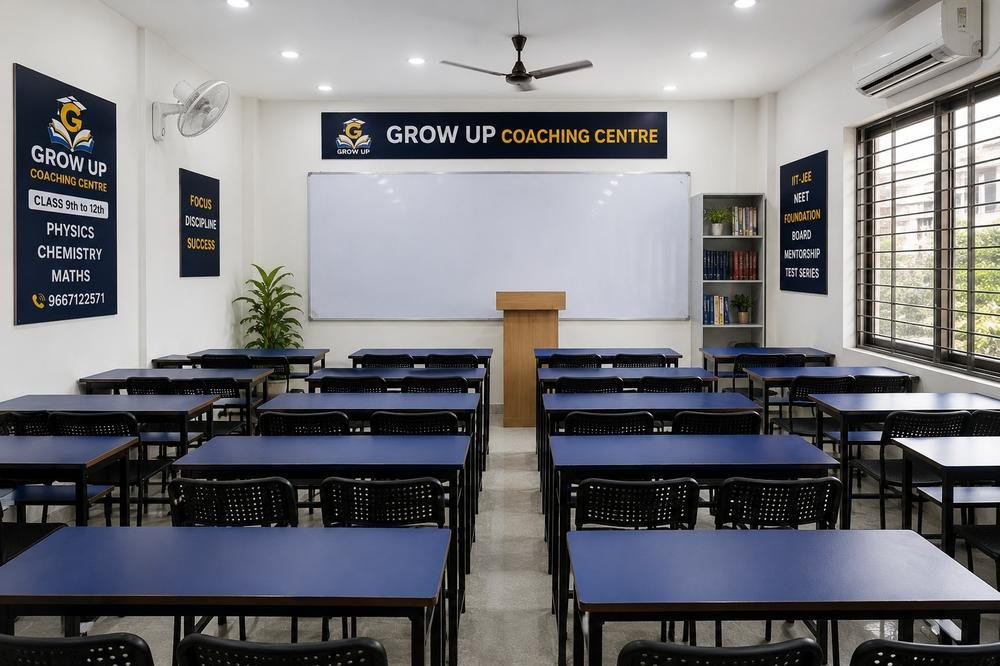
Quick answer — can weak students manage PCM with the right coaching? Yes. We run small batches at Grow Up Coaching Centre in Sant Nagar where students who've struggled in school are given the patience, basics, and daily practice they missed. No rushing, no embarrassment. If you're in Burari and your child is struggling, call or WhatsApp 096671 22571 to talk or book a free demo.
The real reason students become “weak” in PCM
I've taught enough students to know that most “weak” Class 11 kids aren't stupid. They're either missing Class 8–10 algebra basics, or they froze when Physics suddenly became mathematical, or they just had a bad teacher who made them feel small. A child from Kamal Vihar came to us last year — her school physics teacher had told her she'd never clear JEE. She cried. I asked her to solve a simple vector addition problem. She couldn't. I showed her the triangle law on the board, broke it into class 9 geometry, and within 20 minutes she was solving projectile questions. That's not a weak student. That's a student who never had a teacher willing to go back to the foundation.
How we rebuild Maths from scratch — without making it feel childish
The most common gap is algebraic manipulation. A student can understand the concept of integration but can't simplify the expression before integrating. So in the first few weeks, I quietly slip in algebra worksheets. Simple stuff — factorisation, expansions, solving linear equations. I don't announce it as “remedial”. I just call it “warm-up”. Students from Rishi Nagar and Baba Colony who've joined with 40% in Class 10 Maths have told me that this unlabelled bridge work was the first time maths didn't feel like a punishment. Once the algebraic fluency improves, calculus becomes manageable.
Physics — from fear to curiosity
A weak student approaching Class 11 Physics often freezes at the word “numerical”. They've learned to memorise formulas without understanding them. I flip the approach. I start each new topic with a real-life question — “Why does your body lean outward when an e‑rickshaw turns near Burari Chowk?” Suddenly it's not a formula anymore. It's centripetal force. I let them talk, guess, draw. Only then do I introduce the equation. For students from Bengali Colony and Harit Vihar who always sat at the back in school, this conversational method has been a game-changer.
Chemistry — making the invisible visible
Organic chemistry terrifies weak students because it looks like a foreign script. I teach it as a story. Electron‑rich attacks electron‑poor. It's a mugger and a victim. I draw the arrows slowly, again and again. I let students come to the board and draw mechanisms themselves, even if they make mistakes. That's how you learn — by doing, not by watching. Parents from Amrit Vihar and Timarpur who were told their child “can't do chemistry” have seen their child start to enjoy drawing reaction pathways within two months.
The batch environment — why small size matters so much
In a class of 30, the weakest students hide. They sit at the back, copy the board, and never ask a question. In our batch of 8–12, I can see who hasn't written a line in the last five minutes. I walk over, check the notebook, and quietly ask, “Yeh step samajh aaya?” The student nods or shakes their head, and we fix it right there. No public shaming, just a private correction. This is the single most important factor in helping students who've previously failed or barely passed.
What parents can do at home — beyond coaching
Don't compare. I've seen parents in Laxmi Vihar and Sant Nagar compare their child's 55% to the neighbour's 95%. That kills a child's willingness to try. Praise the small improvements. If your child solved three extra problems today, celebrate it. If they asked a doubt in class for the first time, acknowledge it. The emotional environment at home is half the battle. Coaching provides the structure, but confidence is built at the dining table.
If your child has been labelled “weak” and you're tired of hearing that PCM isn't for them, walk into our Sant Nagar centre. I'll spend time with the student, understand where the cracks are, and tell you honestly what can be done. The demo class is free. Call or WhatsApp 096671 22571.
Can a weak student survive PCM in Class 11?
Yes, absolutely. Many students who scored 60-70% in Class 10 have done well in PCM with the right support. It takes patience, a teacher who explains from the basics, and a batch where no one feels embarrassed to ask a simple doubt. At our Sant Nagar centre, we work with such students every year.
What if I have backlogs from earlier chapters?
We first identify the exact gaps — often it's weak algebra or basic trigonometry. Then we run parallel bridge sessions alongside the regular class for 2-3 weeks until the student is caught up. The backlog shrinks quickly once the root cause is fixed.
How do you handle a student who's lost confidence in Maths or Physics?
We start with simple, confidence-building problems before gradually raising the difficulty. The idea is to create small wins every day. Within a month, most students begin to participate voluntarily in class and their fear reduces.
Is there a separate batch for students who are behind?
We don't label batches as 'weak' or 'strong'. But we keep our total batch size small (8-12) so we can give individual attention. Students who need more help get extra worksheets and can stay back 15 minutes after class for additional doubt clearing.
Looking for something more specific? See our Coaching for Students Weak in Maths page.
Your child isn't weak — they just need the right start. Free demo.
Sant Nagar, Burari · Mon–Sat 9 AM–9 PM · Call or WhatsApp 096671 22571
💬 WhatsApp to Book a Demo