Class 12 Physics Ray & Wave Optics — High-Weightage Chapter Guide for Burari Students
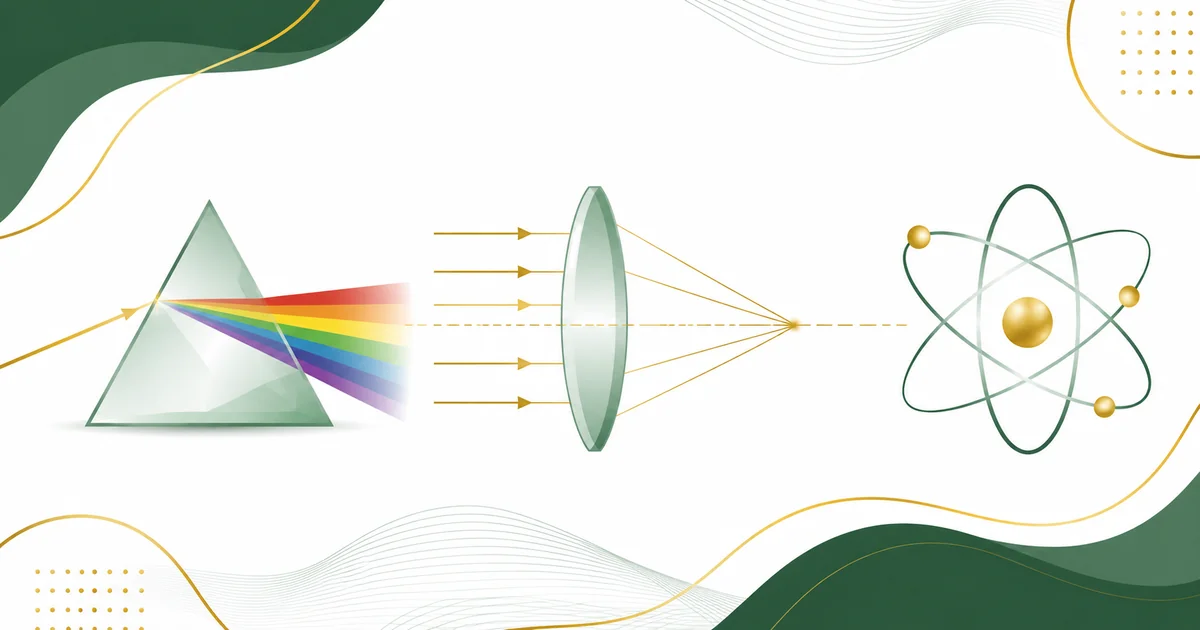
Ray Optics and Wave Optics together form the single largest block of marks in the Class 12 Physics syllabus. Every year, CBSE sets questions worth 14 to 18 marks from these two chapters combined. In JEE Main, optics consistently yields 2 to 3 questions. If you are looking for reliable Class 12 Physics Ray Optics coaching in Burari, this guide is exactly what I teach in my classroom at Grow Up Coaching Centre in Sant Nagar — thorough, concept-driven, and focused on what actually appears in exams.
Why Optics Is the Most Scoring Section in Class 12 Physics
I say this to every new batch: Optics is a gift. Unlike electromagnetism, which demands comfort with vectors and calculus, optics relies on geometry, algebra, and a handful of sign conventions. Once you master the sign convention and the lens formula, a huge portion of the numericals become plug-and-play. The derivations are straightforward — refraction at a spherical surface, lens maker's formula, prism formula, Young's double-slit experiment, and diffraction. These are repeated year after year with minimal variation. Students from Nathupura and Kamal Vihar who struggled with electromagnetism have consistently turned their Physics scores around by acing optics.
Wave Optics, in particular, is a chapter where board questions are extremely predictable. Young's double-slit experiment fringe width formula, the conditions for constructive and destructive interference, and a basic question on diffraction or polarisation appear in nearly every CBSE paper. Prepare these four subtopics thoroughly, and you lock in a guaranteed 7 to 8 marks.
Ray Optics — The Geometry of Light
Ray Optics treats light as a straight line travelling in a medium, bending at interfaces according to the laws of reflection and refraction. It explains how mirrors and lenses form images, how prisms disperse white light, and how optical instruments like microscopes and telescopes magnify distant objects. The entire chapter is built on two foundational tools: the sign convention and the mirror/lens formula.
The Cartesian Sign Convention — Your Absolute First Priority
I cannot stress this enough. The Cartesian sign convention is the single most important thing to lock down before you solve a single numerical. Light travels from left to right. Distances measured in the direction of incident light are positive; those measured against it are negative. The focal length of a convex lens is positive; a concave lens is negative. Object distance u is always negative for a real object. Focal length of a concave mirror is negative; convex mirror is positive. Write these rules on the first page of your optics notebook. Every time you solve a problem, open that page, check the signs, and only then plug values into the formula. In our Sant Nagar batches, I make students solve the first ten numericals with the sign convention chart open beside them. After that, it becomes automatic.
Lens Maker's Formula and Refraction at a Spherical Surface
The derivation for refraction at a single spherical surface leads directly to the lens maker's formula: 1/f = (μ - 1)(1/R₁ - 1/R₂). Here μ is the refractive index of the lens material relative to the surrounding medium. For a lens in air, that is simply the refractive index of the glass. The sign of R₁ and R₂ depends on the curvature of the surfaces and the direction of light. A convex surface facing the incident light has a positive radius of curvature. A concave surface facing the incident light has a negative radius. Students often mix these up when both surfaces are convex or when one is plano. Draw each surface separately, label the centre of curvature, and apply the sign rule individually.
Prism, Dispersion, and Optical Instruments
For a prism of angle A and refractive index μ, the angle of minimum deviation Dm is related by μ = sin[(A + Dm)/2] / sin(A/2). This derivation appears in boards almost every year. Know it thoroughly. Dispersion is the splitting of white light into its constituent colours. The dispersive power of a prism is (μv - μr)/(μy - 1). A direct-vision prism is a combination of crown glass and flint glass prisms that produces dispersion without deviation.
Optical instruments — simple microscope, compound microscope, and astronomical telescope — are tested through ray diagrams and magnification formulas. For the compound microscope, magnifying power when the image is at infinity is (L/f₀)(D/fe), where L is the tube length, f₀ the objective focal length, fe the eyepiece focal length, and D the least distance of distinct vision. For the telescope, it is f₀/fe. Draw the ray diagrams neatly, label the lenses, the focal points, and the angles subtended. Board examiners award marks for correctly drawn and labelled diagrams.
Wave Optics — Proving That Light Is a Wave
Wave Optics deals with phenomena that cannot be explained by the ray model: interference, diffraction, and polarisation. The central idea is Huygens' Principle: every point on a wavefront acts as a source of secondary spherical wavelets, and the new wavefront is the envelope of these wavelets. This principle elegantly explains reflection, refraction, and the bending of light around obstacles.
Young's Double-Slit Experiment (YDSE) — The Crown Jewel
YDSE is the most important experiment in Wave Optics. Coherent light from two slits S₁ and S₂ produces an interference pattern of bright and dark fringes on a screen. The fringe width β = λD/d, where λ is the wavelength, D is the distance to the screen, and d is the slit separation. The path difference for a bright fringe is nλ; for a dark fringe, it is (2n-1)λ/2. If one slit is covered by a mica sheet of thickness t and refractive index μ, the central fringe shifts by (μ - 1)t D/d. That shift question is a classic exam favourite. Always draw the diagram, mark the path difference, and write the condition step by step. Rushing leads to sign errors.
Diffraction and Polarisation — Short but Important
Diffraction through a single slit produces a central maximum with angular width 2λ/a, where a is the slit width. The condition for the nth secondary minimum is a sinθ = nλ. Polarisation demonstrates the transverse nature of light. Malus' Law states that when completely plane-polarised light passes through an analyser, the transmitted intensity is I = I₀ cos²θ, where θ is the angle between the polariser and analyser axes. Brewster's Law: when light is incident at the polarising angle ip, tan ip = μ, the reflected and refracted rays are perpendicular. These are one-mark or two-mark questions in boards and straightforward objective questions in JEE.
Common Mistakes in Ray and Wave Optics
After a decade of correcting optics answers in Burari, here are the mistakes I see repeated most often.
- Incorrect sign convention in mirror and lens problems. Using a positive u for a real object, or confusing the sign of f for concave and convex mirrors. The only cure is disciplined, repeated use of the Cartesian sign convention table. Never guess a sign. Look it up until it is muscle memory.
- Forgetting the refractive index of the surrounding medium in lens maker's formula. If a lens is immersed in water, μ in the formula becomes the refractive index of lens material divided by that of water. A classic board problem asks for the focal length of a lens in a liquid. If you use the glass refractive index directly, the answer is completely wrong.
- Mixing up fringe width in YDSE with fringe width in diffraction. In YDSE, all bright fringes (except the central one) have equal intensity. In single-slit diffraction, the central maximum is twice as wide and much brighter than the secondary maxima. The fringe width formula β = λD/d applies to YDSE; single-slit central maximum width is 2λD/a. These are different formulas. Keep them separate.
- Drawing incomplete ray diagrams for optical instruments. For the compound microscope, the objective forms a real, inverted, and enlarged image at the focus of the eyepiece. The eyepiece then acts as a simple magnifier. If your diagram does not show the intermediate image clearly, you lose marks. Draw with a sharp pencil, use a ruler, and label every part.
- Ignoring the approximation in lens formula numericals. The lens formula 1/f = 1/v - 1/u assumes thin lenses and paraxial rays. If a question seems to give an unusually large object distance or asks for a thick lens, these approximations may not hold — but Class 12 problems stay within the paraxial limit. Do not overthink. Apply the formula as given.
How to Study Optics for Maximum Marks in Boards and JEE
- Create a sign convention cheat sheet and use it religiously. Put it on your study wall. For a convex lens, f is positive. For a concave lens, f is negative. For a real object, u is negative. For a convex mirror, f is positive. For a concave mirror, f is negative. Refer to it for the first 50 problems. It will become second nature.
- Derive lens maker's formula and prism formula from scratch twice a week. These are board exam gold. Writing them out repeatedly trains your hand to produce the derivation cleanly under time pressure. Focus on the algebraic steps and the sign handling.
- Solve all NCERT examples and back questions. The NCERT Optics chapters contain some excellent conceptual questions — especially the ones asking you to reason about the path of a ray through a glass slab or a prism. Do them all. JEE Main often picks numerical values directly from NCERT exercises.
- For JEE, practise questions combining ray optics with coordinate geometry. Questions where a ray passes through a system of lenses and you need to trace the final image coordinates are common. Treat each lens sequentially, using the image of the first as the object for the second. Maintain sign convention discipline throughout.
Why Personalised Coaching Makes Optics Easier to Master
Optics is visual. You need to see ray diagrams being drawn, you need to watch a teacher trace the path of a ray through a lens system, and you need someone to look at your diagram and say, "The arrow on the object should be upward, and the image is inverted — so draw it downward." In a large class, these individual corrections get lost. At Grow Up Coaching Centre in Sant Nagar, Burari, I can sit beside a student, watch them work a lens problem, and catch a sign error at step two before it cascades. That kind of attention is what turns an average score into an excellent one.
Students from Bengali Colony and Rishi Nagar have walked into our centre confused about which lens is converging and which is diverging, and walked out confidently solving telescope magnification problems. The transformation comes from teaching that is patient, visual, and responsive to individual doubts.
Three Practical Tips from a Physics Teacher with Ten Years of Experience
Tip 1: Use the "real-is-positive" trick as a quick check, but never for the final answer. In a rough calculation, you can temporarily treat object distance as positive for a real object and focal length as positive for a converging lens, just to estimate the approximate image position. Then switch to the Cartesian sign convention for the actual solution. This double-check catches gross errors like placing the image on the wrong side of the lens.
Tip 2: Memorise the fringe width formula as a sentence, not just symbols. "Fringe width equals wavelength times distance to the screen divided by slit separation." That sentence encodes β = λD/d. When you read a YDSE problem, the three numbers you need are almost always given directly. Repeat the sentence, plug in the numbers, and the answer is there. No confusion about which symbol goes where.
Tip 3: For optical instrument numericals, always draw a quick sketch before touching the formulas. Mark the objective, the eyepiece, the focal lengths, the tube length, and the final image position. This sketch takes thirty seconds and clarifies whether the final image is at infinity or at the near point. The formula changes slightly depending on that condition. A sketch prevents you from applying the wrong version.
Why Burari Families Trust Grow Up Coaching Centre for Class 12 Physics
We are a local coaching centre in Sant Nagar, 110084 with a simple philosophy: teach fewer students, teach them better, and treat every single one as if they were our own child. Our Class 12 Physics batches cover every chapter from Electrostatics to Semiconductors, with special emphasis on high-weightage sections like Optics. Students from Bengali Colony, Nathupura, Amrit Vihar, and all around Burari have prepared for their board exams and JEE with us, and many have come back to tell us that Optics was the section they scored full marks in. That is the kind of result that keeps us going.
If your child is in Class 12 and feeling overwhelmed by the sheer number of Physics chapters, remind them that Optics alone can secure nearly 30 percent of the board marks. Focus, guided practice, and a teacher who can explain things clearly — that is the formula for success.
Book a Free Demo Class Today
We invite you to experience our teaching before making any decision. Book a free demo class on Ray Optics or Wave Optics — whichever topic you find most challenging. Sit in, participate, and decide for yourself if our approach works for you. There is absolutely no obligation.
To schedule your demo, call or send a WhatsApp message to 096671 22571. You can also visit our centre at Sant Nagar, Block B, Burari, New Delhi – 110084. We are easy to find and always ready to welcome a new learner. If our teaching has already made a difference for you or your child, please take a moment to leave a Google review. It helps other families in Burari discover quality Class 12 Physics Ray Optics coaching in Burari, and your honest words mean the world to a small local centre like ours.
You may also find our other PCM study guides helpful as you plan your preparation.
FAQs
What is the most important topic in Class 12 Ray Optics for board exams?
The most important topics are the derivation of the lens maker's formula, refraction at a spherical surface, and the magnifying power of a compound microscope and an astronomical telescope with ray diagrams. Numerical problems based on the mirror and lens formulas, combined with the Cartesian sign convention, are asked in almost every CBSE paper. Practise these five derivations and the associated numericals thoroughly to secure a strong score.
How do I avoid sign convention errors in optics problems?
The only reliable way is to keep a small sign convention table — listing the sign of f, u, v, R for each type of mirror and lens — in front of you while solving problems. With consistent practice across 50 or more numericals, the sign assignment becomes automatic. Always draw a rough diagram and place the object and the optical element on the principal axis before writing any values. This visual habit reinforces the correct signs.
Where can I find expert Class 12 Physics Optics coaching in Sant Nagar, Burari?
Grow Up Coaching Centre in Sant Nagar, Block B, Burari, New Delhi – 110084 provides small-batch Class 12 PCM coaching with a strong focus on high-weightage chapters like Ray Optics and Wave Optics. The centre offers personalised attention, board and JEE-focused preparation, and a free demo class for new students. It is conveniently located for learners from Sant Nagar, Bengali Colony, Kamal Vihar, Nathupura, and surrounding areas. To book a free demo, call or WhatsApp 096671 22571.
Book a FREE Class 12 Physics Demo
Sant Nagar, Burari · Mon–Sat 9 AM–9 PM · Call or WhatsApp 096671 22571
💬 WhatsApp a Demo